St Teresa’s is committed to providing an appropriate and high quality education to all the children who attend our school. We believe that all children, including those identified as having special educational needs have a common entitlement to a broad and balanced academic and social curriculum, which is accessible to them, and to be fully included in all aspects of school life.

We will grow together to promote high quality education to all children through an inclusive curriculum and environment, whilst promoting positive mental health and well-being.

St Teresa’s is committed to inclusion. We work to develop cultures, policies and practices that include all learners. We respond to learners in ways which take account of their varied life experiences and needs.

At St Teresa’s RC Primary School we aim to raise the aspirations of and expectations for all pupils with SEN, through quality first teaching, early identification and through graduated as well as personalised approaches to learning.

Through our Catholic values, we will create an environment where the children will feel safe, happy and build their sense of self-worth.

The school SENDCO (Special Needs and Disabilities Coordinator) is Miss McCandless.  If you have any concerns or would like to discuss anything further, please make an appointment at the school office.

Our objectives are to:

  • To ensure the SEN and Disability Act and relevant Codes of Practice and guidance are implemented effectively across the school.
  • To provide learning opportunities of quality that challenge our pupils to reach their full potential.
  • To develop a whole school approach towards addressing SEND.
  • To ensure that children’s needs are identified and appropriate action taken as early as possible.
  • To ensure that children’s progress is regularly monitored and evaluated.
  • To consult with other professionals as and when necessary.
  • To ensure that the Governors are aware of, and make provision for, all children with SEND.
  • To provide specific input, matched to individual needs, in addition to differentiated class room provision, for those pupils recorded as having SEND.
  • To involve parents/carers at every stage in plans to meet their child’s additional needs.
  • Where possible, to involve the children themselves in planning and in any decision making that affects them.

There are four broad areas of need outlined in the SEND Code of Practice 2014.

  • Communication and Interaction.
  • Cognition and Learning.
  • Social, Emotional and Mental Health Difficulties.
    Sensory and/or Physical Needs.

At St Teresa’s RC Primary School we understand these categories broadly identify aspects of primary areas of need. However, we also understand that we must consider the needs of the child as a whole.

The responsibility for initial assessment of a child’s SEND lies with the class teacher, in consultation with the SENDCo.

As a graduated response and quality first teaching are at the heart of whole school practice, we are continually assessing, planning, implementing and reviewing our approach to teaching all children.

However, where a potential special educational need has been identified, this process becomes increasingly personalised, as it responds over time to a growing understanding of the child’s barriers to and gaps in learning and an increasingly individualised assessment of need.

We are committed to early identification of children with SEND in order to implement programmes of work which will help the children make progress. We use formal and teacher assessment to help with this identification as well as parental information and involvement.

Special educational provision is educational or training provision that is additional to or different from that made generally for others of the same age. This means provision that goes beyond the differentiated approaches and learning arrangements normally provided as part of high quality, personalised teaching in the classroom.

Areas of Special Educational Need

Special educational needs and provision can be considered as falling under four broad areas:

1. Communication and interaction

2. Cognition and learning

3. Social, mental and emotional health

4. Sensory and/or physical

Many children and young people have difficulties that fit clearly into one of these areas; some have needs that span two or more areas; for others the precise nature of their need may not be clear at the outset and as a school we strive to work with our families to identify any specific needs.

Behavioural difficulties do not necessarily mean that a child or young person has a SEND and will not automatically lead to a pupil being registered as having SEND. However, consistent disruptive or withdrawn behaviours can be an indication of unmet SEN, and where there are concerns about behaviour, there will be an assessment to determine whether there are any causal factors such as undiagnosed learning difficulties, difficulties with communication or mental health issues.

Communication and interaction

Children and young people with speech, language and communication needs (SLCN) have difficulty in communicating with others. This may be because they have difficulty saying what they want to, understanding what is being said to them or they do not understand or use social rules of communication. Children and young people with ASD, including Asperger’s Syndrome and Autism, are likely to have particular difficulties with social interaction. They may also experience difficulties with language, communication and imagination, which can impact on how they relate to others.

Cognition and learning 

Support for learning difficulties may be required when children and young people learn at a slower pace than their peers, even with appropriate differentiation. Learning difficulties cover a wide range of needs, including moderate learning difficulties (MLD), severe learning difficulties (SLD), where children are likely to need support in all areas of the curriculum and associated difficulties with mobility and communication, through to profound and multiple learning difficulties (PMLD).

Specific learning difficulties (SpLD), affect one or more specific aspects of learning. This encompasses a range of conditions such as dyslexia, dyscalculia and dyspraxia.

Social, emotional and mental health difficulties 

Children and young people may experience a wide range of social and emotional difficulties which manifest themselves in many ways. These may include becoming withdrawn or isolated, as well as displaying challenging, disruptive or disturbing behaviour. These behaviours may reflect underlying mental health difficulties such as anxiety or depression, self-harming, substance misuse, eating disorders or physical symptoms that are medically unexplained. Other children and young people may have disorders such as attention deficit disorder, attention deficit hyperactive disorder or attachment disorder.

Sensory and/or physical

Children and young people with sensory and/or physical needs may have a disability or impairment which prevents or hinders them from making full use of the educational facilities generally provided. This may include visual or hearing impairments, multi-sensory impairments, physical disabilities, or sensory processing difficulties. Some children may require ongoing support, specialist equipment or adaptations to the environment to enable them to access learning and participate fully in school life.
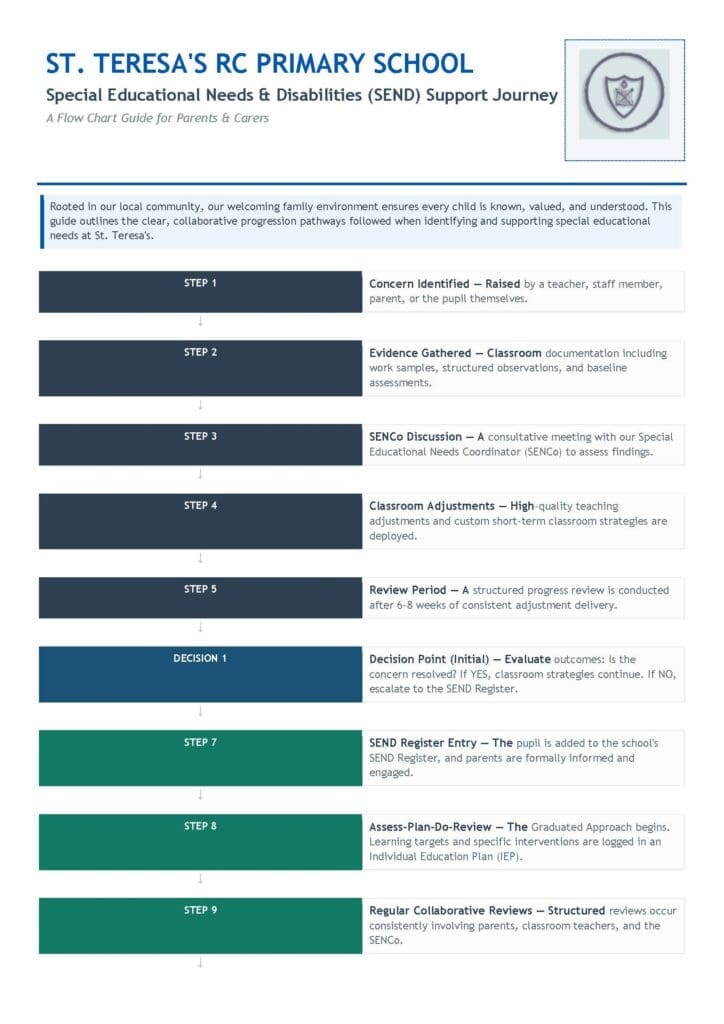
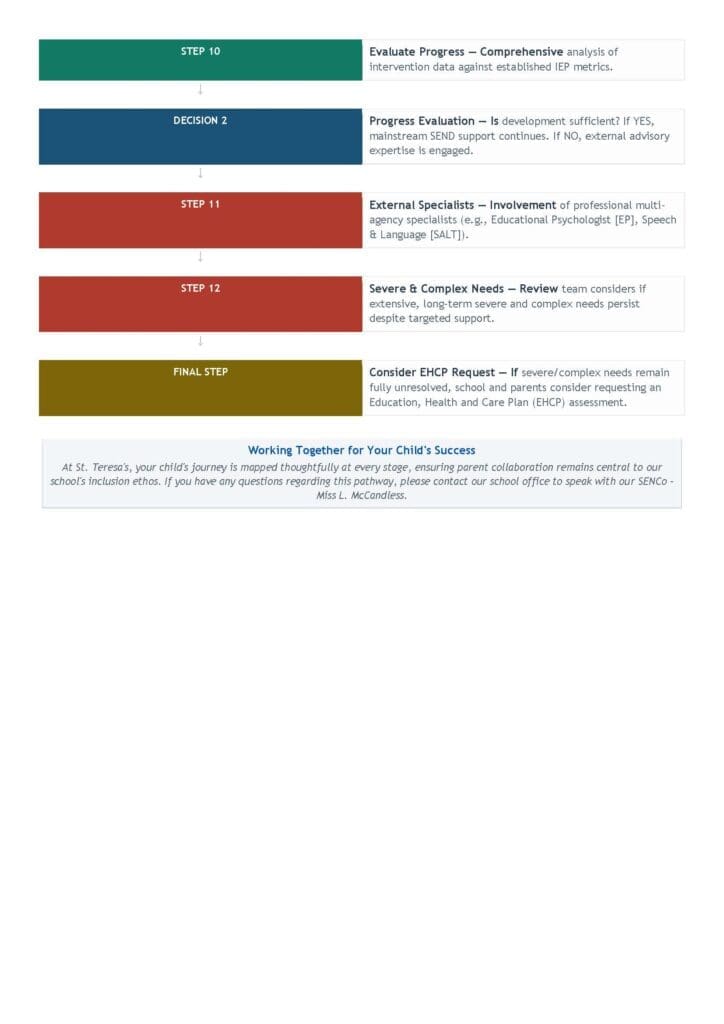
The SEND Code of Practice outlines a category of support called SEN Support as well as children who have an Education Health and Care Plan (EHCP).

We apply the Assess-Plan-Do-Review cycle of steps before placing pupils on the SEND register.

In identifying children who may have special educational needs we can measure children’s progress by referring to:

  • their performance monitored by the teacher as part of ongoing observation and assessment
  • the outcomes from baseline assessment results
  • their progress against the objectives specified in the National Curriculum
  • their performance against the level descriptions within the National Curriculum at the end of a key stage
  • standardised screening or assessment tools
  • use of pre-key stage standards if not reaching level one of National Curriculum expectations
  • use of BSquared assessment tracking tool
  • input from parents/carers

The school maintains a SEND register which contains details of all children identified as having special educational needs. The register is revised and updated throughout the year.

Strategies employed to enable the child to progress will be recorded within an Individual Education Plan (IEP). The IEP will include information about:

  • the short term targets set for the child
  • the teaching strategies to be used
  • the provision to be put in place
  • when the plan is to be reviewed
  • outcomes (to be recorded when the IEP is reviewed)

The IEP will only record that which is additional to, or different from, the differentiated curriculum and will focus upon three or four individual targets that match the child’s needs and have been discussed with the child and their parents. IEP’s will be reviewed in October, January and May. Thereafter, new targets will be set, with the child wherever possible.

Every year we have an SEND Coffee Morning. It is a chance to meet the school’s SENCo, Miss McCandless.  It is an opportunity to meet other parents, share advice, swap strategies and ask questions.  We also invite professionals from outside agencies that work with children with SEND. For example: Speech and Language Therapist, Learning Support Service teachers, Educational Psychologist.

This year’s SEND coffee morning is Friday 11th November at 9am – 10.30am

If you want to complain about our school’s SEN support, you should do so whilst your child is registered with us. This includes complaints that school has not provided support required by your child’s Education Health and Care Plan.

Please talk to our special educational needs co-ordinator Miss McCandless about your complaint. If you do not feel your complaint has been resolved, you should follow our school’s complaints procedure.”

St Teresa’s is a Dyslexia Friendly School and we re-achieved our award successfully in 2019.